Evanescence: The Band That Broke All the Rules — and Won

Updated: Jul 24
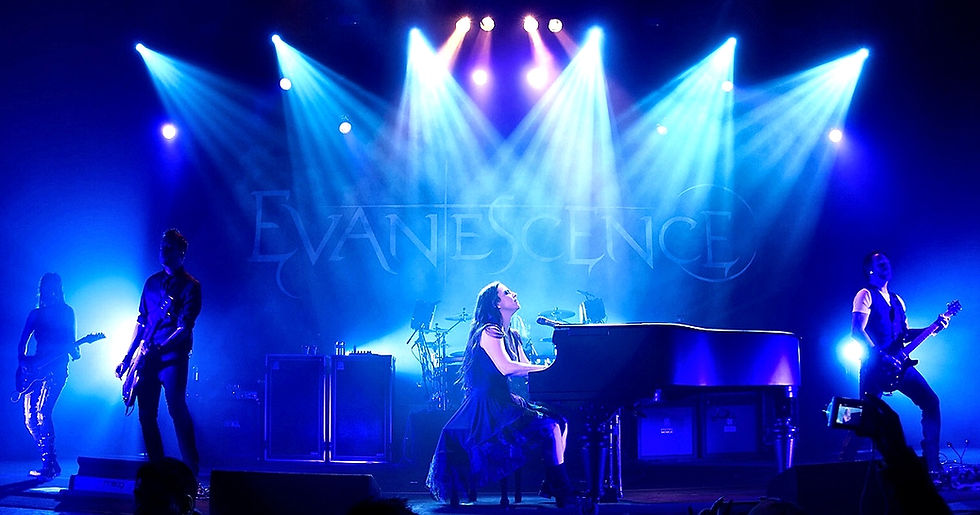
Evanescence by Justin Higuchi, CC BY- 2..0
There's a moment in "Bring Me to Life" — right before Paul McCoy's voice crashes in — where Amy Lee holds a single note on the piano and the world feels like it's tipping on its axis. It's three seconds, maybe four. But those seconds have now pulled in close to two billion streams on Spotify and over 1.7 billion views on VEVO. That's not an accident. That's a song that found something real in people, across languages, decades and continents, and refused to let go.
But before any of that, two teenagers at a Christian summer camp in Arkansas probably didn't fit in very well.
Two Kids in a Basement
Amy Lee and Ben Moody met in 1994 in Little Rock — she was 13, he was 14. Lee was playing piano at camp activities; Moody had an acoustic guitar. She thought they could make something together, and within a month she was handing him a cassette tape of herself singing original songs. From there, they started building Evanescence in the only way they could: quietly, obsessively, in bedrooms and basements, layering fake strings and keyboard choirs onto a 16-track recorder, dreaming of sounds they didn't yet have the means to make.
Lee's vision from the very beginning was something nobody was doing at the time — marrying classical and cinematic drama to heavy rock. She'd grown up on Danny Elfman film scores and found herself hearing similarities between Baroque composers and death metal. That wasn't an accident of taste; it was a genuine obsession with contrast, with the idea that beauty and darkness could live in the same song. She named the project Evanescence — a word meaning disappearance, fading away. They liked that it felt elusive, like it came from nowhere.
They released small EPs in the late '90s, played acoustic sets at bookshops and coffee houses, and eventually put together a demo CD called Origin in 2000 to shop to labels. A producer overheard their demos being mastered at a studio in Memphis, passed them along to Wind-up Records' head of A&R, and everything changed. Wind-up signed them, relocated them to Los Angeles, and let them write.
It wasn't always easy. The label initially pushed back on having a female-fronted band at all. There were fights over instrumentation — at one point, Lee said, her piano-playing rights were stripped from her because Moody felt she was getting too much attention. When the album was finally finished, executives refused to release it unless the lead single featured a male rapper. Lee wasn't happy about it. She wanted "Going Under" as the lead. She reluctantly agreed, wrote the male vocal part herself, and watched "Bring Me to Life" become one of the biggest rock songs of the decade.
Behind the Track: Bring Me to Life
The song that launched everything was almost the song that never was — at least not in the form we know it.
"Bring Me to Life" first appeared on the Daredevil soundtrack in early 2003 before Fallen hit shelves, which meant it was already living in the world, spreading through radio and word of mouth before Evanescence had even played a proper headlining tour. When it was released as a single in April 2003, radio programmers had initially rejected it cold — a woman and a piano on rock radio was practically unheard of. Some program directors switched it off before the first chorus. It took a grassroots fanbase demanding airplay to force radio stations to reconsider.
Once they did, the song was unstoppable. It hit number five on the US Billboard Hot 100 and spent four weeks at the top of the UK singles chart. For Lee, it became complicated — she felt the rap vocal "stamps a time period" on the song, locking it into an era of nu-metal she never felt truly belonged to. She's made peace with it since, mostly because the band proved, through "Going Under" and everything that followed, that Evanescence couldn't be reduced to one song or one sound.
The music video was directed by German director Philipp Stölzl and filmed in Romania in November 2002, months before the song was even officially released as a single. Stölzl leaned into the gothic urgency of the track: a towering apartment building, fog-draped skyscrapers, Lee in a nightgown, sleepwalking on a ledge while the band plays on another floor of the building above her. Remarkably, Lee did all her own stunts — Stölzl later said he wasn't sure if he'd need a double for most of the dangerous angles, "but then it turned out that Amy did everything herself, hanging on Paul's arm for hours without getting tired. In the end, she is the one who made that shot strong." The central image of Lee dangling from a building while McCoy's voice pulls her back became iconic almost immediately, and MTV called that sequence the "money shot" of the video. It's the kind of visual that feels inseparable from the song — you hear one and see the other.
For us at Soundevote, it's a track that still hits the same way it did the first time. So does "My Immortal," which is a completely different animal — spare piano, almost no percussion, Lee's voice completely unguarded. And "Going Under," which was always the more honest statement of what Evanescence could do in the harder register. All three from Fallen, all three essential.
Fallen turned out to be more than a debut. It spent 43 weeks in the Billboard 200's top 10, sold over 17 million copies worldwide, and won two Grammy Awards: Best Hard Rock Performance for "Bring Me to Life" and Best New Artist. It launched Evanescence from club shows to arenas in under two months.
Life on the Road, and Off It
Evanescence has never been a band that treats touring as a formality. Even in the early Fallen days, when Moody quit mid-tour in Europe in 2003, and Lee improvised a foursome to keep the shows going rather than cancel them, there was a refusal to let the live experience fall apart. She called former Cold guitarist Terry Balsamo to fill in immediately, and he became a permanent member.
Over the years, they've played Nobel Peace Prize concerts, headlined South American stadiums, performed with full orchestras on the Synthesis Live tour, and co-headlined with Korn. Their 2022 Worlds Collide tour with Within Temptation, rescheduled four times due to COVID, finally happened and ran across Europe into December of that year. In 2023, they played Download Festival's 20th anniversary in England to what was described as the biggest crowd ever for the second stage — a set Metal Hammer listed among the greatest Download performances of all time.
Away from the stage, Lee has spoken openly about what it cost to navigate the music industry as a young woman in the early 2000s — the objectification, the control, the fight to be recognised as the actual author of her own music. She wrote most of Fallen while dealing with an abusive relationship and the illness of her brother, and described feeling largely alone through the band's explosive rise. The music absorbed all of it. That's a big part of why it connects.
Who's in the Band Now
Evanescence today looks quite different from the duo that played bookshops in Little Rock. The current lineup is Amy Lee on vocals, piano and keyboards; Tim McCord on guitar (he played bass for the band from 2006 to 2022); Will Hunt on drums, in the band since 2007; Troy McLawhorn on guitar, also since 2007; and Emma Anzai on bass, who joined in 2022 after coming over from Sick Puppies.
The road to this lineup involved several significant departures — Moody's dramatic mid-tour exit in 2003, the firing of John LeCompt and departure of Rocky Gray in 2007, Will Boyd leaving after The Open Door, Terry Balsamo's exit in 2015, and Jen Majura's departure in 2022. Each change reshaped the band, and Lee has spoken about how the shift from duo to genuine band collaboration — which really took hold on the 2011 self-titled album — changed how the music was made for the better.
What's Coming
Evanescence has never really stopped. After The Bitter Truth in 2021 — the record Revolver called a rebirth — they've been writing and recording for their sixth album, Sanctuary, due June 5, 2026. The lead single, "Who Will You Follow," dropped in April 2026. Before that, Lee collaborated with Halsey on a track for the Ballerina film, teamed with K. Flay on "Fight Like a Girl" for the same project, and contributed "Afterlife" to the Netflix anime Devil May Cry. A headlining world tour begins in June 2026, with Spiritbox, Poppy, Nova Twins and K. Flay as support across various dates.
Over thirty years in, with 31.9 million albums sold, Evanescence remain one of the best-selling hard rock acts of all time. And Amy Lee, the teenager who handed a cassette tape to a kid with a guitar at summer camp, is still the one making sure every note matters.
Some bands chase a sound. Evanescence found one that was entirely their own — and never let anyone take it from them.
👇 Follow Evanescence


Comments