Ice Nine Kills: Where Horror Becomes Music, and Music Becomes Theatre

Updated: Jul 24
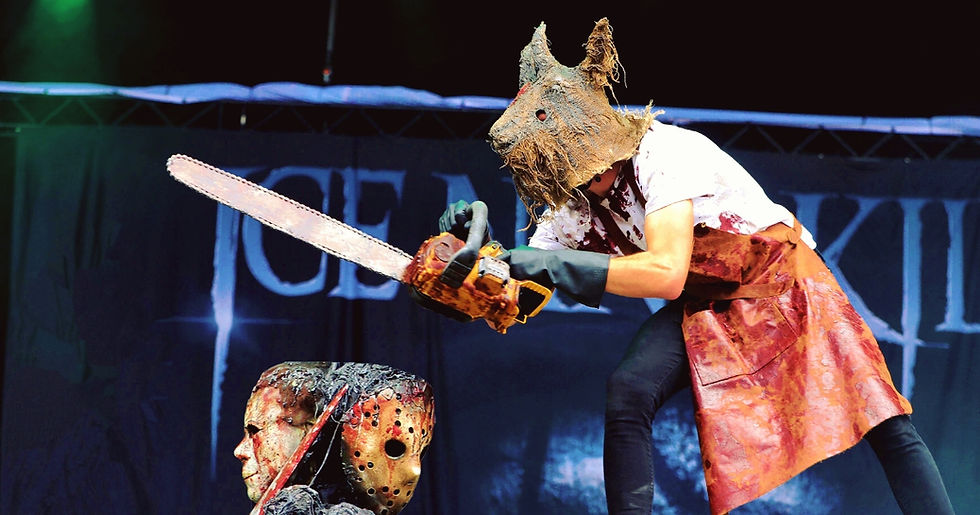
Ice Nine Kills by Mr. Rossi, CC BY-SA 4.0
Some bands play heavy music, and some bands build entire worlds out of it. Ice Nine Kills belong firmly in the latter category. This band didn't just evolve but reinvented itself completely, transforming from ska-punk beginnings into one of the most distinctive and theatrical forces in modern metalcore.
From Basement Beginnings to Reinvention
The story begins in Boston, Massachusetts in 2000, when high school friends Spencer Charnas and Jeremy Schwartz formed a band called Ice Nine. At the time, there was no blood-soaked aesthetic, no cinematic ambition — just a group of kids experimenting with ska-punk and alternative sounds.
That version of the band feels almost unrecognisable now.
By 2006, the name had shifted to Ice Nine Kills, and their debut album Last Chance to Make Amends quietly set something in motion. Then in 2009, Schwartz stepped away from the project — life on the road taking its toll. What could have been an ending became a turning point.
Charnas, now the sole remaining founding member, rebuilt the band from the ground up. He brought in former members of Rochester post-hardcore outfit Remember Tomorrow, reshaped the sound, caught the attention of Ferret Music, and pushed toward something heavier, darker, and far more ambitious.
The pivot to metalcore wasn't just a genre shift. It was the beginning of a concept-driven identity that would define everything that followed.

Ice Nine Kills by Fearlesscontent, CC BY-SA 4.0
The Grind That Built the Foundation
Before the theatrical production and sold-out shows, there were years of relentless touring. Warped Tour runs, support slots with As I Lay Dying, A Day to Remember, Paramore, and
Motionless in White — long stretches on the road that defined the band's early growth.
They toured like survival depended on it — because it did.
Albums like Safe Is Just a Shadow (2010) and The Predator Becomes the Prey (2014) steadily sharpened the identity. The latter cracked the Billboard 200 for the first time — a milestone that signalled something bigger was coming. That grind forged a connection with audiences that still defines their live shows today. Beneath the elaborate visuals and horror themes, there's a raw, earned energy that only comes from years spent building a following the hard way.
And when that energy translates to the stage, it explodes — particularly on tracks like Stabbing in the Dark, which takes on an entirely new life in a live setting: heavier, bigger, and fully immersive.
The Horror Identity: More Than a Concept
Then came 2018 — and everything crystallised.
The Silver Scream arrived on October 5th of that year, and it was immediately clear this wasn't just a record. It was a blueprint. Thirteen tracks, each inspired by a different horror film, crafted with a level of detail that blurred the line between tribute and reinvention. The album scanned close to 19,000 copies in its first week and delivered the band their first top 10 Billboard chart entry.
The follow-up, The Silver Scream 2: Welcome to Horrorwood, expanded that vision even further — cementing the band's place in a lane entirely their own.
What makes it work is balance.
Tracks like The American Nightmare — a Freddy Krueger-referencing single with a hook that doesn't just catch you, it takes up permanent residence — and A Grave Mistake showcase a precise fusion of aggression and melody, while maintaining a cinematic structure that feels closer to film scoring than traditional songwriting. The band doesn't just reference horror. They reconstruct it through sound.
Spencer Charnas being named among Loudwire's best clean singers in metalcore in 2023 wasn't a surprise to anyone who had listened closely. The range is real — and it's precisely what allows the theatrics to land without tipping into self-parody.
They've even coined their own genre label: theatricore. And honestly, nothing fits better.
A Band That Lives Its Concept
For Ice Nine Kills, the music is only part of the experience.
The band has expanded its horror-driven identity into a full multimedia universe — from elaborate, narrative-driven music videos to live performances that feel more like staged productions than concerts. Their live album I Heard They KILL Live!!, recorded at The Palladium in Worcester, Massachusetts, in 2020, captured exactly what this band is capable of in a room full of people who know every word. The accompanying Silver Stream broadcast — weaving live footage with a self-produced horror framing device featuring Bill Moseley — showed just how seriously they take the visual and theatrical side of what they do.
This isn't a band that plays shows. It's a band that stages events.
Their ventures extend further still — into conventions, graphic storytelling, and film-adjacent projects, all orbiting the same core idea: total immersion. At the centre of it all is Spencer Charnas, whose vision has remained constant through years of significant lineup changes. Drummer Patrick Galante, who had replaced Conor Sullivan in 2018, parted ways with the band in October 2024. Bassist Joe Occhiuti stepped in for Justin Morrow in 2019 when Morrow left to join Motionless in White.
Members have come and gone. The identity has never wavered — because it was never accidental.
It was always intentional.
Walking the Line Between Innovation and Criticism
Not everyone has known what to make of Ice Nine Kills.
Genre labels have struggled to contain them — metalcore, post-hardcore, horror punk, symphonic metal — none quite capturing the full picture. Criticism has occasionally followed, particularly around the band's theatrical approach, with some questioning whether the spectacle overshadows the music.
But that criticism tends to fade under closer inspection.
Because beneath the blood, the references, and the stagecraft, the songwriting holds up. The hooks land. The structure is deliberate. The execution is tight. And with each release cycle, the gap between concept and credibility continues to close.

Ice Nine Kills by Mr. Rossi - Own work, CC BY-SA 4.0
2026: Blurring Film and Music Even Further
Fast forward to 2026, and Ice Nine Kills are operating exactly where they've always seemed destined to be — at the intersection of music and cinema.
On February 15th, they released Twisting the Knife, a collaboration with McKenna Grace — actress and co-star of Scream 7 — as part of that film's official soundtrack. It's a move that feels completely natural for a band that has spent years building a bridge between those two worlds. Grace's contribution adds something genuinely unexpected, and the cinematic music video leans hard into the Scream aesthetic without losing what makes the band distinctly themselves.
The track is sharp, atmospheric, and unmistakably theirs — layering intensity and narrative into something that works both as a standalone song and as part of a larger horror universe. As theme songs for horror franchises go, it sits near the top.
Final Cut
Ice Nine Kills aren't just a band you listen to — they're a band you experience.
From ska-punk roots in a Boston basement to writing songs for major horror film franchises and hosting their own horror conventions, their journey is one of constant reinvention, creative risk, and total commitment to a vision that could have easily failed in less dedicated hands.
Instead, it's thriving.
They've built something rare: a fully realised world where music, film, and performance collide — not as separate elements, but as one cohesive, ever-evolving nightmare.
And at this point, they're not just part of the genre anymore.
They're redefining what it can be.
👇 Follow Ice Nine Kills


Comments