The Man Behind the Storm: How a Kid from Eura Changed Electronic Music Forever

Updated: Jul 24

Darude by Vass Lauricella, Public Domain Mark
There's a track that needs no introduction. You hear those first four notes and something animal happens — in a stadium, at a wedding, on a football terrace, it doesn't matter. Jaws drop. Arms go up. People who don't even like dance music start moving. That's the power of Sandstorm. And the man who made it, Toni-Ville Virtanen — better known to the world as Darude — is still quietly baffled about how it all happened.
A Village Kid With a Tracker Program
Darude grew up in Hinnerjoki, a small village in Eura, in the Satakunta region of southwest Finland. Not exactly the epicentre of the global dance music scene. But music got under his skin early. He'll tell you his first real memory of it was pestering his parents because a Finnish pop song hadn't played on the radio one morning — he was three years old and already obsessed.
Formal music education didn't stick. A bad experience with a school music teacher who kept putting him on the spot killed his enthusiasm for a few years. But at around 18 or 19, everything changed when he got to Turku Polytechnic and a couple of classmates showed him tracker software. Suddenly it clicked — you didn't need to be a virtuoso live player to make music. You just needed ears, patience, and the willingness to sit in clubs analysing hi-hat patterns instead of dancing.
For the next few years, that's exactly what he did.
How Sandstorm Was Actually Born
Most people assume Sandstorm arrived fully formed. The truth is stranger and better.
The core of the track started life as a study exercise around 1997. Darude was trying to dissect another song — learning how arrangements were built — and he needed a placeholder for one section. He knocked together a loop using a cheap, badly-recorded single-note sample from what was basically a 303 bassline with the filter nearly closed. It sounded dull. Then he left it on his hard drive for two years and forgot about it.
In the summer of 1999, he pulled it back out. On a whim, he ran it through a distortion unit.
"The doo-doo was born."
That crappy, low-quality 8-bit sample — pushed through distortion — produced a cascade of strange harmonics. The piercing, unmistakable lead sound of Sandstorm. He built the chord progression around it over the next day or two, burned some copies for local DJs, and eventually handed a CD to a producer he'd been trying to impress for months: Jaakko Salovaara, aka JS16 — the man behind Bomfunk MC's and already a Finnish music legend. Darude had given him two previous demos that JS16 almost certainly never listened to. Third time, it worked.
Within a week, they were in the studio together. A week after that, the version the world knows was done — recorded mostly live, with filter sweeps and reverb washes all performed by hand because the MIDI controller wasn't cooperating with JS16's Atari. The kick drum is a real Roland 909. The iconic synth chord pad in the breakdown? That came from a Roland JP-8080 factory preset called Sand Storm. Two words. The name practically chose itself.
It was originally called Back in the Time. Good thing they changed it.
A Runaway Train
Sandstorm was released on 16 Inch Records in Finland on 26 October 1999. By the time the wider world caught up in 2000, it had already spent 17 consecutive weeks at number one on the Finnish dance chart. Neither Darude nor JS16 had seen anything like it. "It was beyond our wildest dreams," he said later. "We were like — what the hell is going on?"
The music video — shot in May 2000 — became just as iconic as the track itself. A girl with a mysterious briefcase. A chase through city streets. A pair of agents who aren't quite what they seem. A barking dog. A twist. And Darude himself, watching from the sidelines in sunglasses, eventually waiting on a boat at the seaport for the getaway. It was a staple of late-night MTV and VIVA, a genuinely cinematic piece of work — aided in no small part by a Danish steadicam operator whose fluid, running camera work was cutting-edge for a music video at the time.
Sandstorm reached number three in the UK — the first record by a Finnish artist to do so — and cracked charts from Canada to Australia. By the end of 2000 it was the world's biggest-selling 12-inch single. It has now racked up over 600 million streams on Spotify and more than 300 million views on YouTube. Some reports put total sales across formats at around five million copies worldwide.
The Road Never Really Stopped
What followed was three years of near-constant touring that Darude was barely prepared for. He wasn't a DJ when Sandstorm broke — he was a producer who'd barely played a live gig. He had to learn on the fly: how to build a set, how to read a room, eventually how to beatmatch vinyl. His debut album Before the Storm sold 800,000 copies worldwide and earned him three Finnish Grammy Awards. A second album, Rush, followed in 2003. By the 2010s he'd co-founded his own label, EnMass Music, and was playing landmark slots at Tomorrowland and Future Music Festival in Australia.
He represented Finland at Eurovision in 2019 alongside singer Sebastian Rejman. It wasn't his finest chart moment — they didn't qualify from the semi-final — but it said everything about his stature in his home country that he was the one they called.
In 2025, Darude embarked on the Storm 25 world tour: a full producer live set built in Ableton, with around 25 tracks running as stems that he can manipulate in real time. New remixes, live keys, 303 filter tweaks on the fly. A return to his roots as much as a celebration of them.
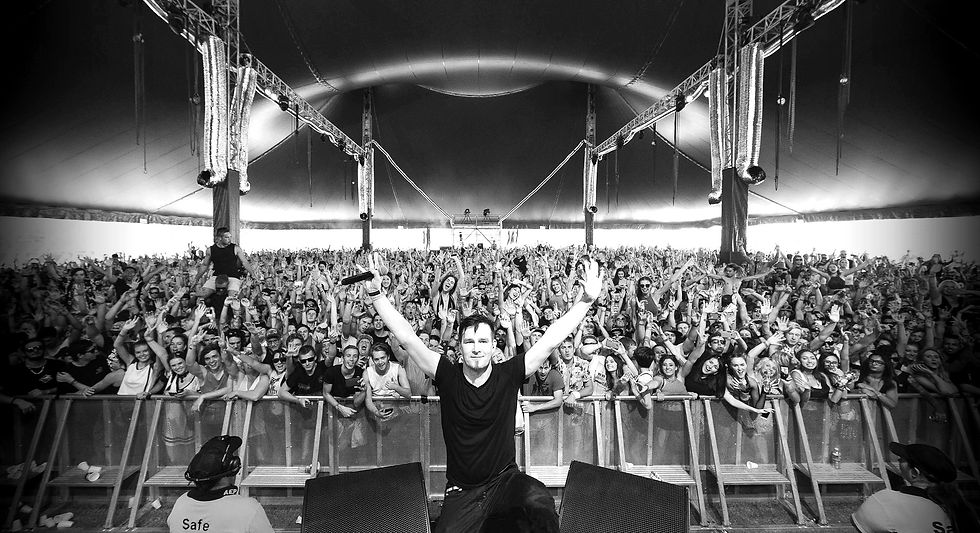
Darude by Vass Lauricella, Public Domain Mark
Still Going
Ask Darude the secret of Sandstorm's longevity and he'll be honest with you: he doesn't entirely know. He knows every millisecond of the track, every sample in it. And still, twenty-five-plus years later, he can't fully explain why people don't get tired of it. His best theory: a great hook that you recognise immediately, built around sounds you can't quite forget, arranged in a way that somehow never outstays its welcome.
New music is coming. The Storm 25 tour will carry over into 2026. And somewhere, right now, Sandstorm is probably playing at a sporting event, a school disco, an NHL game, or possibly a funeral.
The doo-doo lives on.
👇 Follow Darude


Comments