Run-D.M.C.: The Queens Trio That Rewrote the Rules of Hip-Hop

Updated: Aug 13
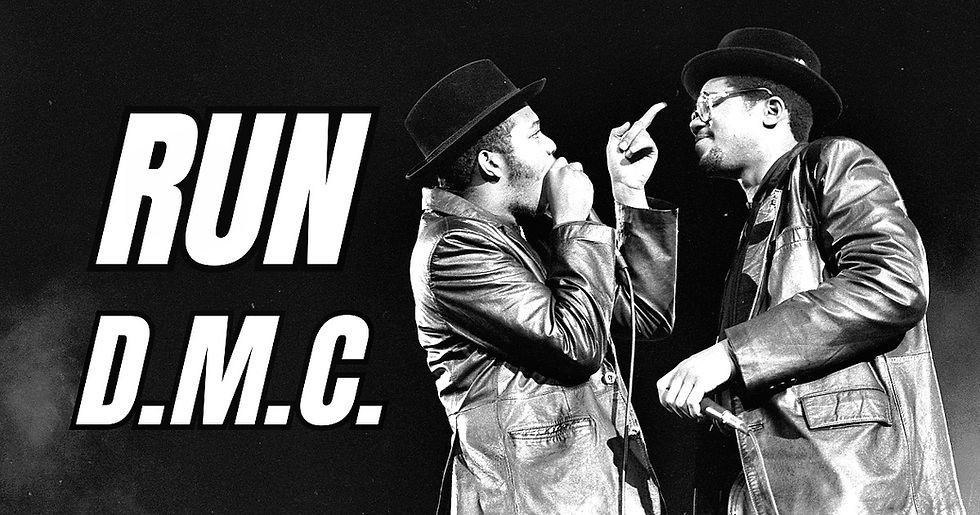
There's a moment in every genre's history where the old rules just stop applying — where three guys from a New York City borough decide the leather-and-rhinestone era is over, and street clothes and a drum machine are enough to change music forever. For hip-hop, that moment has a name: Run-D.M.C.
Formed in Hollis, Queens in 1983 by Joseph "Run" Simmons, Darryl "DMC" McDaniels, and Jason "Jam Master Jay" Mizell, Run-D.M.C. didn't just make records — they built the blueprint. No group in hip-hop before them had gone gold, then platinum, then multi-platinum. No rap act had been on MTV, on the cover of Rolling Stone, on the Live Aid stage, or up for a Grammy. Run-D.M.C. did all of it first, and they did it wearing unlaced Adidas and black fedoras instead of glam-rock costumes.
Three Kids from Hollis
Before the group existed, there were just three teenagers circling the same scene. Run got his start as a hype man for Kurtis Blow, who was managed by Run's older brother Russell — the same Russell Simmons who would go on to co-found Def Jam. McDaniels, meanwhile, was more interested in sports until he picked up a set of turntables and started DJing, eventually finding his voice as a writer of rhymes rather than a performer of them. The two of them used to hang around Two-Fifths Park in Hollis, hoping to catch the attention of the local DJs — and one of the regulars there was a flashy, technically gifted kid named Jason Mizell, known on the scene as Jazzy Jase.

By 1983, Russell finally agreed to help Run and DMC cut a record as a duo, on the condition they bring in Mizell — now going by Jam Master Jay — as their DJ. The group's name, cobbled together from Run's DJ handle and DMC's initials, was one none of them liked at first. It stuck anyway. Their debut single, "It's Like That" backed with "Sucker M.C.'s," landed in late 1983 and cracked the R&B charts, setting up a self-titled debut album in 1984 that made them the first hip-hop act to go gold — followed a year later by King of Rock, the genre's first platinum record.
What made Run-D.M.C. different wasn't just the sales figures. It was the look. They stripped away the glam-disco flash of earlier hip-hop acts and replaced it with something rawer and more street: Kangol hats, Cazal glasses, and — most famously — Adidas sneakers worn without laces, a nod to jailhouse fashion that Run later explained came from prisoners not being allowed shoelaces at all. That single choice turned into a $1.6 million Adidas endorsement deal and arguably the beginning of hip-hop fashion as its own industry.
The Remix That Wouldn't Quit: Jason Nevins, 1997
Run-D.M.C.'s catalog is stacked with essentials — "Rock Box," "Peter Piper," "My Adidas," and of course "Walk This Way" with Aerosmith, which cracked the Hot 100 higher than Aerosmith's own original. But if you're looking for the track that introduced the group to an entirely new generation who weren't even alive for the group's 1983 debut, it's the one that almost feels like cheating: American producer Jason Nevins — a New Jersey native — and his 1997 remix of "It's Like That."
Nevins took the original a cappella and rebuilt it from the ground up as a pounding, hip-house club record — no new verses, no new bars, just Run and DMC's original 1983 vocals riding a completely different, dancefloor-ready production. It shouldn't have worked as well as it did. Instead, it became a phenomenon. The remix hit number one across a huge swath of Europe and beyond, and in the UK it did something genuinely historic: it stopped the Spice Girls' unbroken run of number-one singles cold, holding their song "Stop" at number two and staying at the top of the chart itself for six straight weeks. By the end of 1998 it ranked among the biggest-selling singles of the year in Britain, and worldwide it moved in the neighborhood of five million copies.
The video did just as much heavy lifting as the track. Filmed in Los Angeles inside a stripped-down warehouse, it staged a straightforward but electric premise: a male breakdance crew versus a female breakdance crew, going head-to-head in that raw, industrial setting. The girls win. The guys concede and walk off defeated — a small twist that made the video feel different from the macho posturing common in a lot of '90s rap and dance visuals. The video's dancers weren't hired as an established act; they were scouted individually from LA's real breaking scene, and it shows in the standout moments, particularly from B-boy Kujo, whose power moves became the clip's signature image. A young Vanness Wu — years before he became a pop idol and actor in Taiwan — was also among the male dancers. Two decades on, the track has passed 160 million streams on Spotify and 123 million views on VEVO, and it remains a fixture in DJ sets, still capable of filling a floor the way it did in 1998.
The Loss That Silenced the Group
Run-D.M.C.'s story doesn't have a clean, celebratory ending, and it would be dishonest to write around that. On October 30, 2002, Jam Master Jay was shot and killed at his recording studio in Queens. He was the group's quiet architect — the member who built much of the sound the other two rapped over, and who, away from the spotlight, was mentoring and discovering new talent through his own label, including a young rapper named 50 Cent. His murder went unsolved for close to eighteen years, until two men were arrested in 2020 and ultimately convicted in February 2024. In the immediate aftermath of his death, Simmons and McDaniels made the only call that felt right to them: they ended Run-D.M.C. as a group.
Collaborations, Reunions, and a Final Bow
Even before the tragedy, Run-D.M.C.'s history was built on collaboration — most famously the Aerosmith pairing on "Walk This Way," which didn't just produce a hit but effectively resurrected Aerosmith's career and helped kick off the rap-rock fusion that would define a whole generation of bands in the late '90s. Later years brought guest spots and features from Onyx, Nas, Prodigy, Kid Rock, and Method Man, among others, as the group tried — with mixed commercial success — to find its footing in a changing hip-hop landscape.
After Jay's death, Simmons and McDaniels made only occasional joint appearances, reuniting for one-off festival sets through the 2010s without ever returning to the studio together. That long, quiet epilogue closed formally in August 2023, when Run and DMC took the stage at Yankee Stadium for a "Hip Hop 50" celebration and billed it as their final performance as Run-D.M.C.
It's a fitting place to end, in a way. A group that started in a Queens park, changed what hip-hop sounded like and looked like, and then closed the book in the city where it all began — leaving behind a Rock and Roll Hall of Fame induction, a Grammy Lifetime Achievement Award, and a remix from 1997 that still, somehow, sounds like the future.
👇 Follow Run-DMC


Comments